Horizon 2020 Call: Η2020-LC-SC3-2018-2019-2020
(BUILDING A LOW-CARBON, CLIMATE RESILIENT FUTURE:
SECURE, CLEAN AND EFFICIENT ENERGY) Topic: LC-SC3-EE-1-2018-2019-2020 Decarbonisation of the EU building stock: innovative approaches and affordable solutions changing the market for buildings renovation Type of action: IA
ABOUT SUREFIT
The SUREFIT project (SUstainable solutions for affordable REtroFIT of domestic buildings) aimed to radically accelerate the energy renovation of existing buildings by developing and demonstrating an innovative, fast-track retrofitting approach.
SUREFIT introduced a suite of modular, prefabricated, and cost-effective technologies designed to reduce primary energy use, cut CO₂ emissions, and improve indoor comfort across a wide range of European climates.
The technologies were tested and validated in five demonstration sites (UK, Greece, Spain, Portugal, and Finland), achieving over 60% energy consumption reduction in real residential buildings — significantly contributing to the EU’s climate and energy goals.
Core Project Outcomes:
• Reduction of primary energy use by up to 62%
• Reduction of CO₂ emissions by up to 84%
• Decrease of renovation time by up to 40%
• Improved occupant comfort and indoor air quality
OVERALL CONCEPT
Buildings represent about 40% of the EU energy consumption, and 36% of the total CO2 emissions. A major part of these is due to heating and cooling, to maintain comfortable indoor conditions. The EU has committed to meet 20% of all energy demand through the use of renewable energy sources by 2020, and a further target of 100% by 2050 is already underway. Rational use of energy and integration of renewable energy technologies can substantially reduce the conventional energy demand in new and existing buildings and assist the EU in meeting the climate change objectives under the 2015 Paris Agreement. At present, about 35% of the EU's buildings are over 50 years old and almost 75% of the building stock is energy inefficient but only 0.4-1.2% of the building stock is renovated each year due to slow and costly renovation processes. Systemic approaches for building renovation could address the key challenges facing the construction industry by minimising energy use and material waste, maximising the energy efficiency and the use of renewable energy sources for heating, cooling, power generation and lighting, and fast and affordable retrofitting through the use of prefabrication.
OVERALL CONCEPT
Buildings represent about 40% of the EU energy consumption, and 36% of the total CO2 emissions. A major part of these is due to heating and cooling, to maintain comfortable indoor conditions. The EU has committed to meet 20% of all energy demand through the use of renewable energy sources by 2020, and a further target of 100% by 2050 is already underway. Rational use of energy and integration of renewable energy technologies can substantially reduce the conventional energy demand in new and existing buildings and assist the EU in meeting the climate change objectives under the 2015 Paris Agreement. At present, about 35% of the EU's buildings are over 50 years old and almost 75% of the building stock is energy inefficient but only 0.4-1.2% of the building stock is renovated each year due to slow and costly renovation processes. Systemic approaches for building renovation could address the key challenges facing the construction industry by minimising energy use and material waste, maximising the energy efficiency and the use of renewable energy sources for heating, cooling, power generation and lighting, and fast and affordable retrofitting through the use of prefabrication.
SUREFIT TECHNOLOGIES
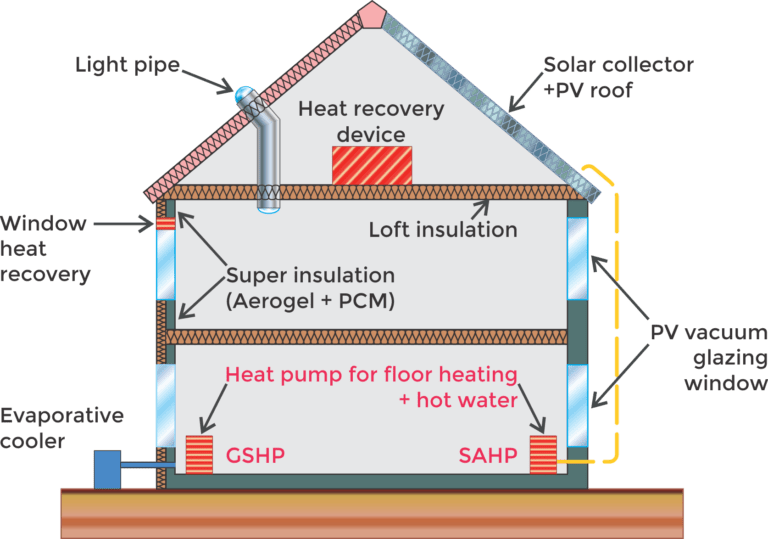
The project integrated advanced solutions including:
• Bio-aerogel and PCM insulation materials
• PV vacuum glazing
• Prefabricated thermal panels
• Window heat recovery systems
• Solar-assisted and ground source heat pumps
• Evaporative cooling systems
• Photovoltaic/Thermal (PV/T) systems
• Daylight louvers
These technologies were selected, sized, and deployed to optimize installation time, energy performance, and cost-efficiency.
SURe³FIT Tool & Handbook
As part of its legacy, the project developed the SURe³FIT decision support tool, a user-friendly software designed to help stakeholders — homeowners, contractors, architects, and public authorities — identify optimal renovation packages based on environmental and economic criteria.
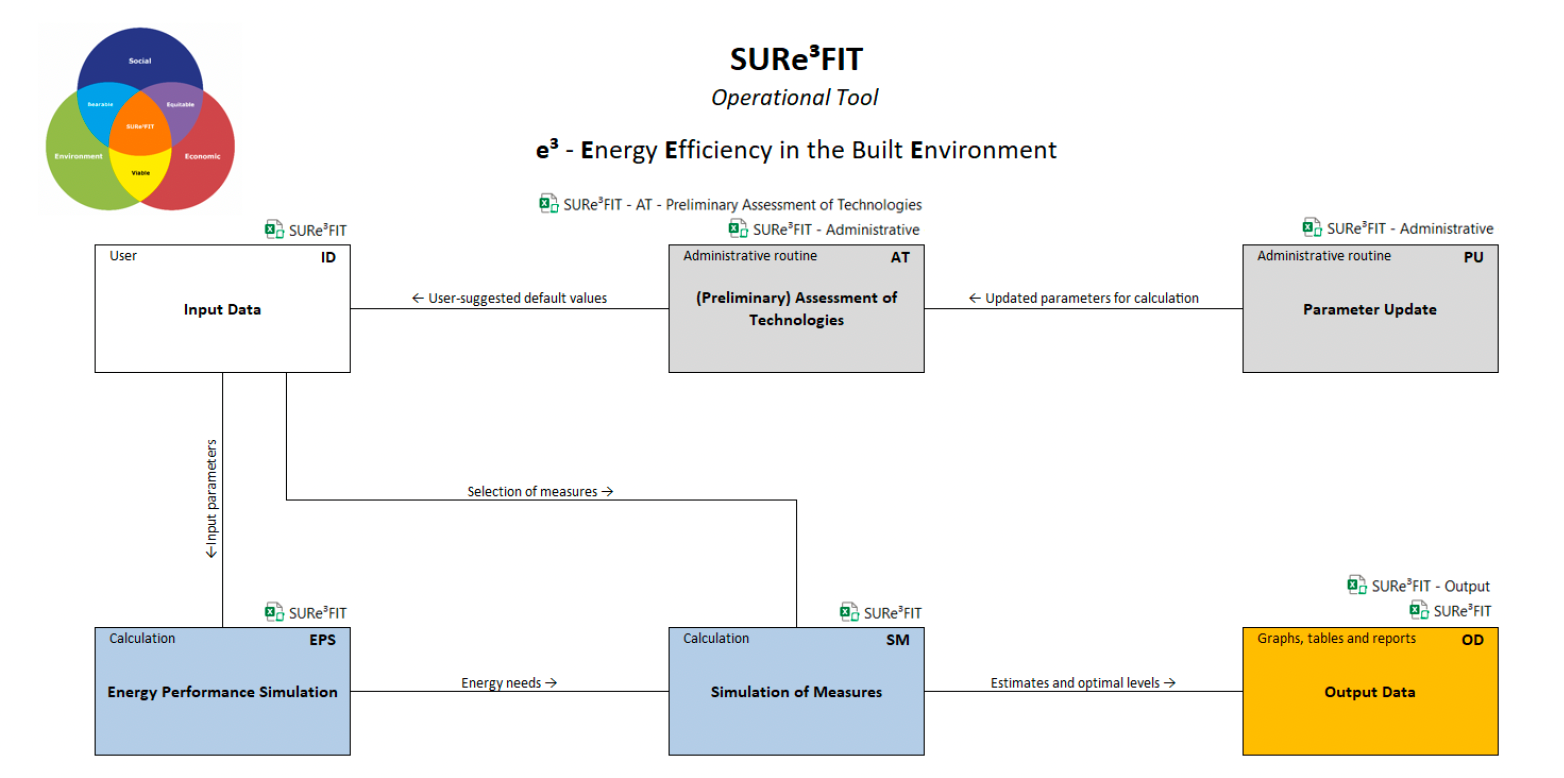
Accompanied by a comprehensive Handbook, the tool provides step-by-step guidance on implementing retrofitting projects using SUREFIT technologies and methodologies.
The SURE³FIT methodology and Operational Tool (Deliverable D7.3) provide an evidence-based decision-support framework for optimizing renovation strategies, integrating environmental, economic, and social sustainability assessments throughout the building’s life cycle. The accompanying Handbook guides users through each step of the process, from initial diagnosis to implementation.
PROJECT’S OBJECTIVES
fast track renovation of domestic buildings
prefabricated technologies
target on near zero energy buildings
increase the share of renewable energy in buildings
innovative technologies involving heating & cooling systems, hot water, lighting, power generation
smart control systems
demonstration in 5 buildings in different climates (demo sites)
development of guidelines and operational tools
innovative business models
We use cookies on our website to give you the most relevant experience by remembering your preferences and repeat visits. By clicking “Accept”, you consent to the use of ALL the cookies. Check our Privacy & Cookies Policy.
This website uses cookies to improve your experience while you navigate through the website. Out of these cookies, the cookies that are categorized as necessary are stored on your browser as they are essential for the working of basic functionalities of the website. We also use third-party cookies that help us analyze and understand how you use this website. These cookies will be stored in your browser only with your consent. You also have the option to opt-out of these cookies. But opting out of some of these cookies may have an effect on your browsing experience.
Necessary cookies are absolutely essential for the website to function properly. This category only includes cookies that ensures basic functionalities and security features of the website. These cookies do not store any personal information.
Any cookies that may not be particularly necessary for the website to function and is used specifically to collect user personal data via analytics, ads, other embedded contents are termed as non-necessary cookies. It is mandatory to procure user consent prior to running these cookies on your website.
Oncontrol Technologies is a SME dedicated to engineering, automation, control and information technology systems. The company has large expertise in designing and deploying control infrastructure to industry. We offer services in all automation levels, from instrumentation to high level corporate information. Our solutions include, energy monitoring, advanced control, artificial intelligence and process monitoring & visualization. We employ Artificial Intelligence, Machine Learning and Fuzzy logic, in our services to industry, in order to create value and gain insights from process and/or shop floor. We are also experts in remote monitoring solutions, specializing in systems where we need to have a PLC-based control. In these situations, our solutions provide data collecting and direct access to PLC for programming and system maintenance, which is different from other solutions in the market. The company has a complete portfolio of solutions to operational-technical-strategic levels. The company major success is an advanced control system, based on Fuzzy Logic, for mill optimization, to the cement and mining industry. Our control system has achieved improvements in the order of 4-10% and reduction of specific energy consumption (KW/ton) in the order of 5-20%.
Founded in 1970, the CJR Group is a multinational business group, headquartered in Guimarães, Portugal, with projects in more than 20 countries. This group is segmented by two main companies, CJR, SA, being its core business the construction of roads and buildings and CJR Renewables, specialized on renewable energy sector. Over 50 years of operation, the company has been expanding its operational reach. The CJR, SA started its journey renting heavy machinery, an activity still in operation, alongside the construction of roads and infrastructures, becoming a full scope engineering and construction company, also acting on buildings, rehabilitation, urban projects and environmental projects. CJR Group is well known by its projects in engineering, construction and renewable energy.
The New Energy Technologies Group (NEW) at Aalto University (formerly Helsinki University of Technology) in Espoo- Otaniemi, Finland is actively involved with the science and research of advanced energy technologies and systems. The Group has some 20 members working on solar cells, fuel cells and urban energy systems, including materials and complex systems work. The Group has worked in the past with PV-facades, BIPV technologies, Intelligent Buildings, Building Energy Simulations, Solar Cities, Polygeneration, among others. The New Group has operated in the past a test site for multifunctional facades, in particular advanced PV designs, such as thin film PV, translucent PV, and PV façade elements. This included also a fully-controlled PV testroom. The Group has several in-house simulation codes for advanced building energy simulations, incorporating multifunctional façade elements to whole building simulation environment including a range of buildingrelated RES technologies. This includes also polygeneration systems.
FSM | FUNDACIÓN SANTA MARÍA
LA REAL DEL PATRIMONIO
HISTÓRICO
FMS (Santa María la Real Foundation) is a non-profit organisation founded in 1977, whose fundamental mission is to promote sustainable development initiatives based on heritage and the natural and human environment of this heritage. It undertakes interdisciplinary works on the patrimony objects restoration, including architects, engineers, historians and restorers. Main activities are related to restoration or conservation of the old buildings, preserving their integration in a natural environment. Today, the institution has become a prime example that heritage can fuel economic development in an area. Moreover, the Santa María la Real Foundation has created a development model based on heritage that is being successfully exported to other places, regions and countries. In each and every one of Fundación Santa María la Real departments encourages the generation of ideas and projects based on the principles of quality, efficiency, and innovation so that heritage itself can become an element in generating socio-economic development.
KÖSTER Lichtplanung Ltd.’s daylight technology is worldwide applied for more than 20 years with over 400,000 m² glass roofs and facades. Here are some of the recent construction projects with daylight systems from the office KOST Lighting design: Bank Santander in São Paolo/Brazil; BlueWin Tower in Zurich / Switzerland; Headquarters of the SCHOTT Glass AG, Mainz/Germany; Highrise of the Energie AG, Linz/Austria; Triple Towers, Sofia/Bulgaria; Kassenärztliche Vereinigung KVWL, Dortmund/Germany; Standard Bank of South Africa, Johannesburg/South Africa; Central Bank of Kuwait; Laboratory building Hoffmann-La Roche, Basel/Switzerland; Building projects in Beijing/China; Office building BNP- Paribas, Paris/France.
PCM Products Ltd. (PCM) specialises in phase change material (PCM) technologies/HVAC systems and their applications. The company has research and development facilities and also manufacturing base in the UK and license outlets around the world which offer bespoke products to meet unique customer and application requirements. The company has expertise in chemicals and materials including desiccants, PCMs and adsorbents. PCM is committed to providing improvements to current storage, heating/cooling technologies by offering more energy efficient and environmentally-acceptable solutions. For more than a decade, the company has been involved in the development of PCMs, energy storage, desiccant and HVAC systems. With unrivalled experience in designing and advising on PCM storage installations and applications, it continues to push the boundaries In desiccant materials usage for the benefit of its ever-growing customer base. In addition, PCM Products Ltd has been providing full consultancy and product development services for more than two decades.
Founded in 1988, WINCO Technologies is a French company specialized in thermal and acoustic insulation. Acting in different countries all over Europe, Asia and America, WINCO Technologies has historical partnerships in automotive, iron and steel, petrochemical and military industries. In 2003, WINCO Technologies decided to share its know-how to the world of construction by providing innovative thermal insulation solutions. Based upon permanent innovation and entrepreneurship, WINCO Technologies vision is to improve energy efficiency, comfort and safety.
SOLIMPEKS is a market leading provider of cutting edge technology in the solar energy field, established in Konya (Turkey) in 2009. It is part of a global network expanding over 70 countries, with over 40 years of experience in developing, manufacturing and distributing high end products for commercial and residential use. SOLIMPEKS manufactures the highly acclaimed aesthetically appealing Hybrid PV-Thermal (PV/T) solar collectors to achieve both hot water and power generation from the sun as a clean and free energy source. A combination of solar PV and solar thermal in a single unit, it is capable of delivering twice as much renewable energy in the same rooftop footprint as standard solar, therefore also delivering twice as much carbon displacement.
University of Nottingham (UNOTT) is a research-led University in the United Kingdom with annual research awards totalling €190 million. It has the largest number of top-rated (by Higher Education Funding Council) Departments in UK Universities for research following Cambridge, Oxford and London Universities. It is the home of many ground breaking discoveries and inventions such as magnetic resonance imaging, and is also the 4th ranked UK University for research grant income from private industry.
AMSolutions Ltd is an SME, founded in 2004 with the goal to provide state-of-the-art technical services and contract research to both public and private companies. Its activities are focused on two main areas: • “Turnkey eco-solutions” improving the energy efficiency of the buildings. • Research, production, integration and application of various environmentally friendly materials to improve energy efficiency in building, including new insulating materials and coatings. • AMS has great experience in large civil engineering projects gathered during the Athens Olympics. It has extensive experience regarding advanced industrial applications, having successfully commissioned over 100 projects. • AMS has cooperated to the development and implementation of innovative eco-solutions with numerous companies active in building and the energy sector, ranging from oil processing to solar panel manufacturing.
ISQ is a private non-profit making technological association with Public Utility status. ISQ’s mission is to contribute to the constant improvement of industry and services, resulting in an expanded international presence, by collaborating with the state, regional councils and businesses with regard to the sharing and development of technology, new products and processes, structured management practices and quality control, hygiene and safety, energy conservation and environmental protection, and systematic maximization of human resources. The strategy of ISQ growth goes through an increasingly important and sustained presence in the world having offices, branches and affiliates in 20 countries.